Tales for Canterbury via JC Hart

Initial Announcement:

Christchurch, New Zealand, and the wider Canterbury region, was rocked yesterday (22.2.11) by another round of serious earthquakes. This time they struck during the middle of the day causing more devastation, and loss of life, to a city still trying to pick up the pieces from last September’s quakes.

In an attempt to do something, anything, to make a difference, we are putting together an anthology of short stories loosely themed around survival, hope and the future. All profits of this anthology will be donated to the Red Cross Earthquake Appeal, or another registered charity aimed at aiding those in need in Canterbury.

The purpose of this Anthology is two-fold—to help financially, but also, we hope, to provide entertainment and alleviation in a time of crisis. We hope that our words will help make a difference.

We have already begun to approach authors, and the response is encouraging. Mainly due to time pressures, this anthology will be by invitation. However, if you are an established writer, and keen to contribute, please feel free to get in touch with us at just.cassie.hart@gmail.com. We are looking for stories between 1,500 and 5,000 words, of fairly upbeat nature in the general, literary, science fiction or fantasy genres.

Feel free to repost this and get the word out!

via Tales for Canterbury | by J.C.Hart

Is ‘Write What You Know’ Blocking You From Your Writing Goals?

I think it’s a disservice when phrases make the rounds without proper context.

I experienced this when I was aggressively pursuing my fitness goals.  I’m pretty methodical, and don’t deviate from what I know works: lift weights, sprint, eat real food (but not too much).  But, I have friends on fitness forums/blogs confused by every “new” thing they hear on well-meaning news outlets and reality shows.  Things like:

“Good carbs, bad carbs”

“Say NO to Cardio”

“Calories in, Calories out”

Within the fitness community, these phrases have context and when used and understood correctly, can help you achieve your physical fitness goals.  Otherwise, these phrases can seem vague, meaningless, or contradictory and ultimately, can frustrate someone who really wants to achieve lasting physical changes.

Write What You Know.

I know most writers treat the phrase “Write what you know” cautiously, and have learned to deal with it in their own way, whether through modifying it, defining it, or defying it.  I know writers who have defined the phrase broadly, such as researching more or tapping in to another person’s experience.  I know others who have defied it by saying simply, “Just Write”.  I kinda did all three when I chose to rephrase it as: “Write what you can dream.”

The crux of the statement that may hinder anyone outside of the writing community from taking that leap of faith into the writing world is that pesky “know”.  But once you can overcome the limits you place on your definition of the word “know”, you will begin to feel a sense of freedom.  Almost like you’ve given yourself permission to write as freely as you want to.  I know I felt that way.  I have often thought, “well, what’s the point in writing about that because I don’t know everything there is to know about it?”  Once I changed my hangup around the word “know” and started believing in “write what I can dream,” my motivation and drive to accomplish my writing goal increased exponentially.

I will be talking more about inspiration sometime soon, but when it comes to “finding inspiration” (or what I call, filling up my dream well), I think Stephen King said it best: “If you want to be a writer, you must do two things above all others: read a lot and write a lot.”  The more stories you consume the more fodder your subconscious has to work with.  Snippets of your everyday will form great landscapes and endless worlds.  All you have to do is feed your muses.  Keep them entertained and eventually, they will deign to give you a few golden threads you can follow as you navigate your writing path.

SO TELL ME: What are some writerly phrases that you think send mixed signals outside of a writing community?  Are there phrases that you have redefined along your writing journey that inspires you better? Thank you for commenting

Being A Published Author Wasn’t Always My Dream Job

I Have a Confession

I haven’t always dreamed of being a published author.  Nor have I spent my childhood/teens/college years diligently writing stories with the hopes that others would read my work.  In fact, I spent most of my life keeping anything I wrote private.

I know I’m not alone in my experience.  But, what bothers me is that I was embarrassed about it.  Yes, I was actually embarrassed that I haven’t always wanted to be an author.  So much so, that at one point, I desperately scoured my memory banks to find a scrap of evidence that yes, indeed, I wanted to be an author.  I wanted to stand with those authors who always knew that they wanted to write, and couldn’t imagine being anything else.  The authors who claim that writing for them was like breathing.  I wanted to be able to say that, and if I’m honest with myself, I still want to be able to say that.  To claim that.  Of course, if I do, it would be a lie.

What bugged me more than being embarrassed by something so silly, is realizing why I was so embarrassed.  I’d built up authors beyond being merely role models, that their life stories and beliefs became truth to me.  Became The Way.  And, if I diverged from The Way, then, by my actions, I have excommunicated myself from the society of authors, and I didn’t have the right to pursue being a full-time novelist.

A Side Story

Last week, I was able to spend time with my side of the family.  Because, my immediate family is split between east and west coasts, I only see them for one week, twice a year, and we spend those weeks that we’re together sharing stories about our lives thus far, updating each other on any news.  (This is nothing new.  Growing up, we all often shared stories while eating breakfast on Saturday mornings.)  We’re a talkative bunch, and can be quite dramatic in our renditions, so it takes a good week for us to regale the other branches of the family on our happenings.

Anyway, whenever we’re together, it doesn’t matter that we’ve already heard about each other’s stories through some other means. (For example, my older brother might have called my sister who could have Facebooked me about something my younger brother allegedly did in college that my parents may not know about.  Or, an elderly aunt may have accidentally emailed my sister instead of the Internet scammer who was the intended recipient of said email, and who may have duped her out of money. Again.)  But, until we all get together, we pretend not to know what we all really know anyway, and talk in obtuse pronouns and pronounced facial expressions until the Big Reveal.

What’s important in our ritual story telling over breakfast is sharing the information RIGHT THERE and hearing it from either the source, or from a witness’s first-hand perspective.  The conflict is always more heated, the emotions, more intense, in these real life re-enactments.  (In case you’re wondering, my favorite perspective is from my momdad, seen as one unit because they can’t seem to take turns telling a story, nor can they stop editorializing, so they’re like a two-headed, story-telling juggernaut.)

My Point?

Though I may not have written epic fantasies when I was six years old, I grew up surrounded by stories.  My family breakfasts were proving grounds for telling the best stories, especially since we lived the stories that we told.  It really wasn’t a matter of us telling the truth or not, more like the truth abounded in the conviction that what we told actually happened.  That we believed what we said.  In the telling, our “characters” refused to be flat and lifeless.  My parents can make buying groceries a more interesting story than hearing about a multiple car pileup on the news.  They can’t help but be enigmatically complex and full of conflict.  When my family orders dinner or pays the bill, drama surely follows.

I realize now that I was silly to feel like I had to legitimize my claim for wanting to be a published author.  I’m grateful that I’ve been able to experience stories.  That I was born to a family of storytellers.  Though I didn’t necessarily scribble stories about princes and knights or ghost tale massacres, I told the stories that have surrounded me my whole life (some journals may have been filled with angsty-teen, anti-parent rants.)  Besides, we all have to follow our own writerly path.

So, I’ll let other writers talk about how they’ve been writing stories before they can walk, and how writing to them is like breathing.  For me, I can embrace my heritage of story telling.  If it weren’t for my family, and our stories, then I wouldn’t have become such a devourer of tales.  Creating more stories, albeit in written form, is just an extension of that.

Stories are my life, and that is not only a truth that I can claim; it’s one that I’ve lived.

SO TELL ME: What did YOU want to be when you grew up?

10,000 Hours

Outliers (book)

Image via Wikipedia

“In study after study, of composers, basketball players, fiction writers, ice-skaters, concert pianists, chess players, master criminals, this number comes up again and again. Ten thousand hours is equivalent to roughly three hours a day, or 20 hours a week, of practice over 10 years… No one has yet found a case in which true world-class expertise was accomplished in less time.

~Daniel Levitin, as qtd by Malcolm Gladwell, Outliers: The Story of Success

Since I started becoming serious about my writing goals, I’ve allowed myself to experiment and play, knowing that I have many more hours of work ahead of me before I will ever feel comfortable bearing the label “writer.”  So far, I’ve learned to prioritize my time and focus on my goal (which in my case was to write a novel).  I’ve learned to turn off my internal editor and push through obstacles, like feelings of inadequacy, to finish a novel no matter what (thanks, mostly to NaNoWriMo).  And, I learned that Stephen King’s rule of “write first with the door closed…” definitely applied to me.  I needed to play with my ideas alone so that I can hope, dream, and fear without self-consciousness (read: embarrassment).

My favorite A-ha! moment, though, actually came from unlearning a habit.  Let me explain.

If you’ve read my “About” section, you’ll know that I majored in English in college.  My favorite classes were those in literary theory, and to this day, I can’t read any text without thinking about it from post-colonial, deconstructionist, Marxist, feminist perspectives (my favorites!).  Criticizing and analyzing texts became instinctive to me, which is great when I had to churn out 20-30+ page papers or critique a writing partner’s work.  Not so much when I have to write primary text, and my brain is full of meta text and distancing language.

It took me a long time to refrain from or cut out all the non story that I was prone to writing (back story, character studies, culture studies, whatever) before I was able to write real text, like narrative and dialogue…basically a story that a reader can expect from a novel.  It was a hard shift in my mindset since my primary instinct was to dissect, and not create.  But, with each new novel attempt and failure, I have slowly progressed from being a writer about books to becoming a writer of books.

I’ve begun to develop and trust my instincts for creating worlds. I’m still a sketcher and I’ll always need a big picture goal for direction. But, I will write a scene with more polish and depth than I’ve done previously, and allow my subconscious to play with the “next steps” as I’m exploring the current scene. I’m letting myself focus on the quality of my words rather than merely the quantity of words (though I will keep my word count goals, since I’m still goal-oriented).  Even if it kills me, I will not leave a scene until it makes sense.  My goal for this next story is to finish with a first draft and not a rough draft.  (Some people think they’re the same thing; for me, my rough and first draft are definitely different.)  I’ll always go for the big picture because it’s heartening to see the page count progress.  But in exploring the depth, rather than breadth, I’ll see more of a world than I previously anticipated.  At least, that’s the hope.

Random Note:

I intended to post this last week (January 25, in fact) but I thought it was too silly to post (and I was kinda distracted by Veronica Mars, season 2).  I mean, really, what value can come from posting my infinitesimal progress toward my writing goals?

But, today, I saw the #followreader chat on Twitter, featuring Margaret Atwood, one of my literary heroes.  I decided to ask her this question…

http://twitter.com/#!/LizaKane/status/33273297638662144

…and she answered with this…

http://twitter.com/#!/MargaretAtwood/status/33273683296395265

http://twitter.com/#!/MargaretAtwood/status/33273959608745984

(By the way, how cool is it that I was able to ask her a question and have it answered immediately??)

Turns out, I just need to keep reminding myself that the only way for me to get better as a writer (and teller of stories) is to continue writing.  And the best way for me to continue writing is to celebrate the progress that I’ve made so far, regardless of how small that progress may be.  I plan to keep churning out crappy words, so that one day, I’ll be able to find better words with which to capture my stories.

A Re-Post of “Semper Fi (In Other Words: Have Some Heart, Rebecca)” by Rebecca Rasmussen

Semper Fi (In Other Words: Have Some Heart, Rebecca)

By Rebecca Rasmussen

The first time I walked off the course and back to the starting line I felt justified in my choice to quit. I was in terrible pain. I had lost my breath. I had cramps in my legs, in my heart. Girls were passing me on all sides. Their ponytails were swishing right out of my view. So here’s what I did: I simply walked back to the place I’d started.

The year was 1992, and I was a freshman in high school, thirteen years old. I had a shaky relationship with just about everyone in my family, though I remember my mother coming to this cross-country meet, my first. I remember she wore my dad’s boxy old yellow windbreaker, which I took from his closet the last time I visited him and my stepmom in Spring Green, Wisconsin, though I don’t remember why.

“You’ll do better next time,” my mother said, when she saw me near the starting line.

I’ll tell you this: a part of me wanted to get in the car with her. To stop and pick up pizza at Malnati’s on the way home. To rent a funny movie and eat sour cherry candies. To forget about cross-country and move on to field hockey or dance. Or chess even.

But I’ll also tell you this: an even bigger part of me wanted something else entirely, something I couldn’t put a name to, but knew as a secret deep in my heart. And that’s what I got—exactly what I wanted—that early Saturday morning in September, while girls sprinted into the chute and parents cheered and brightly colored ribbons flapped in the breeze.

“Come here right now,” my coach, Mr. Baker, said to me, in a voice I thought only parents were allowed to use.

“I think I’ll take her home,” my mother interrupted.

“Not yet,” Mr. Baker said and pulled me away from my mother, which I remember thinking was impressive. People didn’t say no to her.

When we were alone behind a grand old Illinois oak tree, Mr. Baker asked me why I’d stopped running, why I came walking back, why I gave up.

I told him what I told you. Cramps. Pain. Breath.

“I don’t care if you’re the last girl out there and you crawl in on your hands and knees,” Mr. Baker said. “You don’t ever give up like that, do you understand me?”

“I couldn’t go on,” I said, looking at the electric leaves up in the tree.

Mr. Baker put his hands squarely on my shoulders and looked me directly in the eyes, which nobody had ever done before. (I come from a long line of side-glancers.)

“You can always go on,” he said very seriously.

I don’t know why, but I wanted to wrap my arms around this man. His strength and strange, unwarranted belief in me was what I’d been looking for in members of my family and what members of my family couldn’t give me just then, and here Mr. Baker was, a man I barely knew, a man with the bluest eyes I’d ever seen.

“I wasn’t going to win,” I said, knowing then that that was the real reason I’d quit.

Mr. Baker smiled. “This is the first brave thing I’ve seen you do.”

“What?” I said, beginning to smile, too, though I didn’t know why.

“Tell the truth,” he said, and hugged me so securely I thought I’d turn blue. “You’re a good kid, you know. I think you’re going to be all right.”

(Words that were so wonderful I started to cry.)

***

I don’t know if you can teach someone to have heart or not, but that’s what Mr. Baker did for me that day and that strength of heart is what I’ve carried with me all these years. If a door closes, I find another one to try to open. If ponytails are passing me, I go after them instead of giving myself over to negativity and turning away.

Crossing the finish line, having guts and grit, is what’s important to me. Knowing that I didn’t quit—that I don’t quit—makes me proud, confident, happy.

These days, I’m a writer more than I’m a runner, though I still try to hit the pavement four or five times a week. Writing, I’ve learned, takes the same tenacity, the same hard work and hard-won belief in one’s self. I’ve seen so many talented writers give up, and I want to grab them by the shoulders and look directly in their eyes and tell them what Mr. Baker told me. Keep writing even if you have to crawl on your hands and knees.

My first novel is coming out with a large New York press in April. From the outside, my story looks so easy and breezy and, well, full of beauty. The truth is that I fought for my book every single step of the way. I fought for it when people kept saying no for months and months and months. I fought when they said, “we need to think about sales figures.”

I am fighting for it even now.

And you know what: it probably won’t sell a million copies, I probably won’t be able to quit my job and shop at Whole Foods for herbs and nuts and fish, and I probably won’t wake up and see my name in The New York Times any time soon.

But on April 12th, I’ll be smiling. I promise you that.

Writing a book, finding an agent and an editor, finding my way through all of the no, you can’ts! has been the longest race of my life and I’ll have finally made it to the chute—without fanfare, maybe—but on my own two feet.

(A thought so wonderful I know I will cry.)

***

I haven’t seen Mr. Baker since I was a senior in high school. Is he alive? Is he still coaching running? I don’t know.

That warm September day at the cross-country meet was the beginning of a relationship that changed my life. He taught me about being brave, about being bold, about fighting for what you want and deserve in life. He taught me about nourishing myself in every sense of the word.

He told me about his time in Vietnam, about never giving up even when people around him were dying in muddy rice paddies.

I’ll never forget what he said.

Right before the next cross-country race, Mr. Baker and I exchanged presents, if you can call them that. I gave him my father’s old yellow windbreaker, which he wore to most every meet for the next four years, and he gave me a Semper Fi flag he’d had since the war and which I still keep in my treasure box in the closet.

Whenever I find myself alone on the course now, in the middle of a race that’s even less defined than when I was a teenager, I think of Mr. Baker—those blue eyes and that flag—and I keep going.

I keep hearing him say, have some heart, Rebecca.
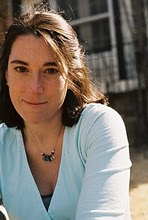
Rebecca Rasmussen is the author of the novel The Bird Sisters, forthcoming from Crown Publishers on April 12th, 2011. She lives in St. Louis with her husband and daughter. Visit her at http://www.thebirdsisters.com