My current novel looks like this now:

I love drafting novels. Love, love, love them. I love being swept away with the story. I love how my fingers fly over the keyboard. I love the fugue state I go into where the external world just drops away, and all I see is my internal world.
Reading what I’ve written, however, is something…else. There are moments that surprise me, of course, flashes of brilliance and heart that make me smile and make me all warm and gooey inside.
But most of the time, reading through one of my first drafts is like trying to glean poetry from vomited up alphabet soup. Not pretty. And, the Not Pretty keeps me from working my revisions as eagerly as I do my drafting.
I can do a whole rabbit trail about mindset and motivation and mental bracing to accommodate the new skillset of revisioning, blahblahblah, but I’ll just cut to the chase: I found a way to get over my issues.
I realized that:
- Everyone’s first draft sucks. They are ALL filled with plot holes, dropped characters, extraneous plot devices, and so much more. I know no one exempt from this universal fact.
2. The effort that goes into revision is ten times harder than writing a first draft, so brace yourself. The revision process is the actual “go to work” version of writing, at least for me. Sure, it could be fun, but it’s still a Responsible thing to do, up there with Eating Kale, Paying The Bills, and Taxes.
3. The work of revision is simply finding where the story dropped the connection with the reader. That’s it. I didn’t need to rewrite from word 0, add multiple subplots, and untwist/retwist the ending. For sure, I’ve done all those things and more over the years, and yes a story may need those things…but it may not. It may just need an extra scene or sentence for clarity. There’s no extra credit for rewriting and reinterpreting your previous draft(s) when the original vision was perfectly serviceable and just needed tweaking.
Revisions always feels daunting to me because I made The Crappy First Draft, so how do I get from CFD to that fun, beautiful, action-adventure that I see when I close my eyes?
This is where my INTJ brain comes in handy. We INTJ-ers love to create systems and make processes more efficient. (This is a pastiche of revising strategies I gleaned from other writers that I made work for me. If you’re familiar with Holly Lisle’s strategies at all, this is basically like that.)
What Did I Want to Write?
First, you can’t hit a target you can’t see. I spend months thinking about my story, dreaming it up, loving it…remembering why I love it and wrote it in the first place. I condense all that love into a series of index cards.
- WHY I WROTE THIS STORY
- Story in a nutshell
- MC story arc
- Themes–major and minor
I eventually transpose those snippets into my writing diary (I have a different one for each WIP) so I’d have them to look back on, but the index cards were important to help narrow my focus and scope. Those who know me well know how I can ramble on and on because I find everything fascinating and pertinent. Index cards don’t have a lot of wiggle room. If I can condense my story on to the front of one index card, then you can too!
I also write a synopsis page of sorts, hitting the high points of the novel so I know which scenes are part of the DNA of the novel–part of the reasons why I wrote the story in the first place.
What I Actually Wrote
Then, I read through the current spine of my novel (about 40-50K words) and print it out, each scene on a new page. I divide the story into scenes, number each scene from 1-infinity. Then, another read through on paper, this time with a spiral notebook where I note all the issues–plot holes, convenient plot devices, characters that jumped to just the right conclusion, etc–including scene and page numbers and reasons why it’s off.
When I finally figure out what I wrote, I line it up with the story I want to see, aka my Ideal Story. The comparison is often brutal, but also reality, and the sooner I get over how wide the gap is between the two versions, the sooner I could work on narrowing that gap.
Prioritizing the Story Problems
I find that the most efficient thing for me to do is to work through Big Picture/Plot issues then work my way down so that the very last thing I worry about is polished prose and Oxford commas.
With that in mind, I make sure each scene gets its own index card scene summary. For easy cross reference, I put the assigned scene number and page numbers on the card. All the issues that I noted in my notebook get assigned a color (Blue for Plot, Pink for Character, Yellow for Setting, whatever) and an alphanumeric label (P1 for the first plot issue in my story). I write that alphanumeric label and page numbers on the corresponding colored post-it tabs, and stick it to that index card.
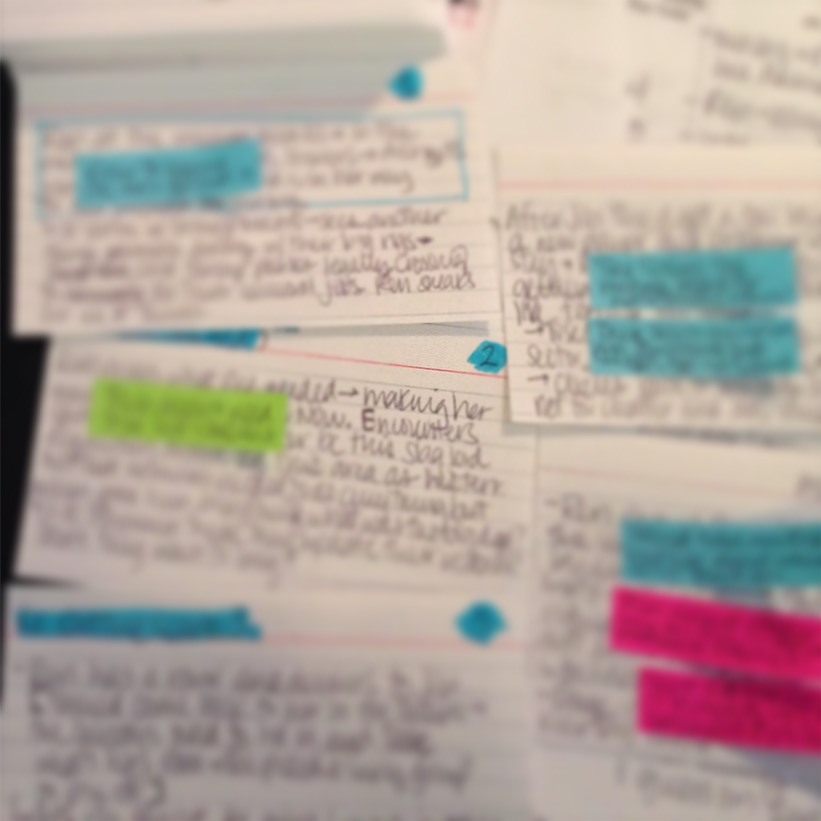
When I finally have my story condensed to color tagged index cards I spread them out and see what I’ve got. Based on the colors, I can see at a glance where my WIP needs the most help, where there are plotting issues or characterization issues. (I recently added a subplot flag to my process, so I can see where I can weave the plot lines together to help with the pacing.)
This is where I can move scenes around and shuffle them up a bit. (Scrivener is a program that I know and love and use…but I enjoy the tactile sensation of literally feeling out my story. Plus I’m convinced that the brain-eye-finger connection works at a different level off screen than onscreen. Not saying it’s better, just different.) When the rearranged scenes look closer to my Ideal Story, I read through the cards again. I use a different color index card to add in new scenes if needed, writing out a summary sentence on the card with elements I need to see in there to make it flow with my Ideal Story.
All of the above sorting and organizing and reading through basically takes me two days. The long part, the hard part, THE STRUGGLE is the long slog of actually making the words better. This arduous march is made so much easier with a clear guide of what was wrong and what I want to see. This process makes revising the content so much more efficient, and I don’t end up wasting countless hours and words on following shiny, exciting rabbit trails.
Beware of Shiny New Ideas
I love to ideate, it’s one of my top five strengths, but I have learned that I need an exceptionally fine filter when it comes to ideas at this stage, and which idea will stick.
Most of the time, it’s my muse BORED TO DEATH and wanting to play with a shiny new idea. I honor the idea, recognize its cool factor, jot it down in my journal, and continue the march onward through my WIP.
Be honest and critical with yourself–Would this new idea really serve the story you want to see, or are you finding yet another reason not to finish this novel?
Editing the Content
The actual edits I do by hand on the printed out version of the ms. This is easy because each scene is paper clipped together, so I just go to my scene card, look at the issues there, reread what’s on the page, and make the words better. Most of the time, it requires giant X’s, squiggly arrows, and just writing stuff out on another piece of paper. (When that happens, I go to the working draft version on my computer and input the changes immediately and print it out again.)
Each scene gets edited until every issue on the scene card is addressed. I do not move on until I do. Once it’s finished, I paperclip the pages together again, and they go into the done pile.
This is the most time consuming aspect but I’ve learned to look at each scene like a micronovel so instead of figuring out how to describe setting, I look at conflict–what are the obstacles here, how is the MC going to overcome those obstacles, and will the MC be successful? Even if it’s a bullet point summary in the margin, at least it helps me grease the groove into crafting better words for my reader.
I’m still going through each scene for WIP 2, weaving the story together. I’ll be done soon. I’ve crossed the tipping point where momentum is taking over, and the flywheel is basically running itself.
It’s all pretty exciting, considering this story has lived in my head for five years. Some day soon, I hope to share it with the world.
If you have any revision tips of your own, I’d love to hear it!


 Liza Kane