Stuck, Redux

Post-it notes

Image via Wikipedia

I’ve been working on my WIP2 for two weeks now, and I’m having So. Much. Fun.

I do have a confluence of inspiration and motivation helping me out, thanks to conversations with my lovely writing friends*, and to life in general (remind me to tell you all about my introduction to resin one day).

Mostly, I’ve decided to slow down and really think about what I write. I have decided to give myself a hiatus from scribbling ANYthing down, including journaling in favor of taking the time to write out a scene and flesh it out as I write out my draft. I would sketch out a scene or a few scenes, and then go back over them again and again, and see how they read with the rest of the story so far, adding, deleting, and revising lines as I go.

Before, having the sketch of a scene was good enough and enabled me to move forward in the story. But, I inevitably get confused about next steps or where to go, and just skip ahead just so I can get to the end of the story. Which was a great confidence booster for WIP1: I made it to The End. Admittedly though, most of what I’d written had no value in the long term. The Hot Mess I’m left with would basically need to be rewritten.

Now, as I’m writing WIP2, I wait, think, and consider my writing as I write it out on the computer. I know that sounds elementary, but you have to understand. I’m a consummate scribbler. I’ve been writing notes and filling out journals for as long as I remember. Sometimes, I write whole scenes, and even once, a whole chapter, on index cards and sticky notes. Writing directly on the computer (I thought) was a death knell to my creativity.

Well, as I have discovered, being stuck and writing at a slower pace (and even waiting to write) does not lessen my creativity. I don’t have to be afraid of forgetting a cool idea or a cool thought. In fact, keeping the story in my head (for now) has helped me think it through one step at a time. I’m usually dying to get on my computer to write even a few words or pages, even after a really long day at work. (Who needs sleep? I’ve basically adopted Thomas Edison’s lifestyle of catnapping my way through a creativity bout.)

Not scribbling every little idea that comes to me while I’m away from the WIP has freed me to reread what I’ve written and expand on scenes, remember buried plot points, start new scenes, move things around. Basically, has made this draft’s beginning stronger than any other first draft I’ve written (and never finished). And, I don’t get discouraged when I’m “blocked” because when I reread what I’ve written, I can always find an idea or thought that I can expand on in a new scene, which feeds other new scenes.

So, I may not be chugging along as quickly as I normally do during moments of rough draft inspiration. But, so far, I’ve written more valuable words for much longer, and that’s worth more to me than phenomenal word counts.

Once I’m halfway through the story, in other words, once the story becomes too big to see all at once (as I can right now), I can see the need to jot down scene sequences Scrivener style to help keep it all straight.

For now, I’m enjoying this story-telling experience. Honestly, I’m still in awe that I’m adding to WIP2, and that it’s growing and evolving. Fingers crossed that I will finish this draft soon, and still look at it with this same loving glow.

I’ll leave you all with this motivating quote I found from Janet Reid aka, Query Shark:

“Writing can be learned.
Syntax can be taught.
Determination is yours and yours alone.”


*conversations including, but not limited to, Michele, Carol, Kayla, Melissa…thank you!

Writing from a Salesperson’s Perspective

Confession: I don’t understand why some writers are so fixated on getting an agent that they rush to query with an unfinished or sub-par manuscript. I would think that they would take the time to ensure that their manuscript is sellable from the query stage.

And no. I’m not talking about genre trends or marketability or writing a book just because you know or feel or think it’s something that can sell.

I’m going after something more basic (and honestly, common sensical, so please bear with me), namely querying agents with a great story, written with the cleanest copy possible (read: no typos or other editing errors).

I’ve worked in sales for at least ten years, and based on the amount of companies that have wanted to recruit me, hire me, and/or promote me, I think I’m a pretty good salesperson. I’m not saying I’m the best salesperson around or the hardest worker (though I am kind of a workaholic). But, I think where I excel is that when I love something I don’t need anyone to tell me to sell it. I will talk up a product because I honestly enjoy it, or it was beneficial to me in some way, and I want to share that joy and benefit with others.

Even if you’re not a sales person, you know what I mean right? It’s essentially word of mouth advertising/referrals. We all have an opinion of who makes The Best Pizza or The Best Burger, or which company has The Best Customer Service. I mean, I’ve never worked for AT&T or Apple, but I tell everyone who’ll listen to me how much I love my iPhone 4 (The Preciousss), and how it changed my life. (Caveat: I use my iPhone as a palm-sized computer, and rarely use it as a phone.) (Seriously. Life changer).

In the same way that I need to love and believe in a product in order to sell it (at least, sell it well), an agent will need that same kind of love and belief in your story.

I know that getting an agent is something that aspiring authors imagine or daydream about. I get it. It’s one step closer to being a traditionally published author.

But, why rush the process, especially if you haven’t finished your manuscript, let alone edited it till your eyes and fingers bleed, and your crit partners want to kill you? It’s still only one step. There are many, many more after that, not the least of which is SELLING YOUR STORY.

Even if you manage to land an agent with a sub-par manuscript, your agent will still need to sell the manuscript that you are querying to him or her. After all, that’s how they will get paid. So then, what help can a sub-par manuscript be at this point? You’ll still need to fix it, edit it, rewrite it before it can sell. You might as well do your best work now, before you ruin your chance of a great first impression. (I won’t bother mentioning that even if an editor is sold on your sub-par manuscript, that he or she will still need to pitch it to the purse strings of the publishing house, who will decide whether or not to proceed with an offer.)

Put in another way, if YOU were an agent, and YOU see a manuscript that still needs LOTS of work, would that be something YOU would want to work through and wait for and maybe hope to sell? Would YOU be willing to bet your source of income on it?

If I essentially worked commissioned sales, I would back the product that I could sell quickly and efficiently. If I were the agent in that scenario, I would look at the sub-par manuscript and see that it will NOT sell quickly because I would need to wait on rewrites and revisions and a possibly hostile writer who may not be open to my suggestions for edits, since the writer clearly didn’t see the need to edit in the first place, otherwise why did he or she submit a sub-par manuscript to me?

As a salesperson, I sell things that I love, that I believe in, that I’m passionate about. When you submit your work to a potential agent, you are asking them to believe in it, to love it, to be passionate about it enough to sell it.

So, please. Take this time to write the best story you can, in the cleanest copy possible. Don’t be in such a rush to query. Don’t stress out so much about finding an awesome agent. Focus on writing an awesome story that an agent would feel privileged to represent. A story that makes them feel like they are holding the book equivalent of an iPhone.

When you have that, then feel free to query your favorite agents, and be giddy over the waiting game. I’ll even supply the chocolates.

This is my strategy. What about you? What are your thoughts or perspectives on the querying process?

This Past Week…

A lot of random things popped up all in the same week that I thought were quite memorable, so I thought to share some of these snippets. I know that normal weeks begin with Sunday and end with Saturday, but I have the privilege of not working a set schedule, thanks to my paythebills job, and Tuesdays generally mark the beginning of my “weekend.” So, without further ado…

20110621-012359.jpg

Thanks for lending me the book, Kayla! Also, I think the cover has changed since this ARC, so don't be confused!

I spent last Tuesday (and into Wednesday) immersed in other worlds, namely, Fran Billingsley’s Chime and (the ARC of) Laini Taylor’s Daughter of Smoke and Bone.

Both of these stories were incredibly written and beautifully characterized. I wanted to wrap the words around me, and live in these worlds. Seriously, these books are what I aspire to as a writer. Unfortunately, Daughter of Smoke and Bone is not available until this fall, but Chime is available now!

I unfortunately missed out on a chat that writerly friends of mine were hosting Wednesday night, but here is the archive of that chat. I think we decided to make it a monthly chat, on the second Thursday of each month.

The next few days after that, fueled by insomnia, caffeine, and the raging desire to work on something fun, I fleshed out a chapter of a story (the snippets of which I wrote back in January) and continued to sketch out “next chapter plots.” I was so proud of myself, this song played in my head all day Friday (thanks to my awesome twitter friend, Michele Shaw, aka @veertothewrite, for tweeting me this link, so I can share the madness with you all):

(You’re welcome.)

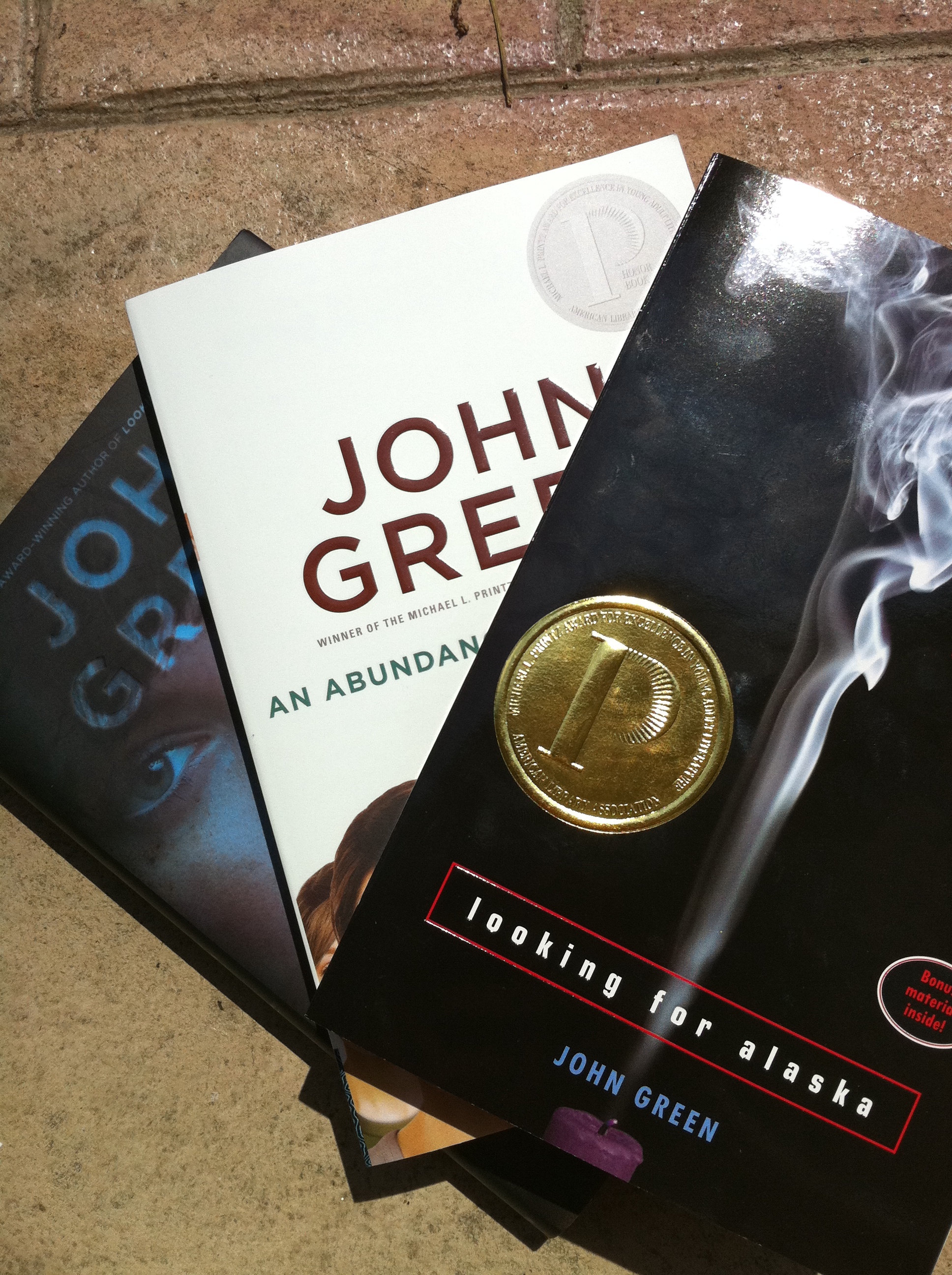
Then, thanks to my lovely friend, Carol, I got these books…

20110621-012154.jpg

20110621-012213.jpg

20110621-012246.jpg

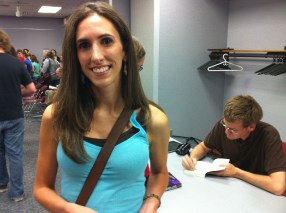
Carol, next in line!

…signed by John Green! (Please visit her blog post, here, where she also shares The Man in Truck incident, and her experiences at WisCon.)

Though I loved getting all three of those books signed, I really appreciated listening to what he had to say about the relationship of the reader and writer, and what he felt was his responsibility as a writer to produce stories that were both helpful and beautiful. Also, we got to hear bits from his new book, the title of which will be released next week. (UPDATE: John Green has announced that the new book’s title is The Fault in Our Stars. He will be signing all pre-ordered copies! Go order one today!)  The book itself comes out in nine months, and from what I heard, I will DEFINITELY be lining up to buy a copy (which will hopefully be signed, too, one day!)(UPDATE#2: Since JG announced he would be signing pre-ordered copies, mine is already signed, but I don’t mind getting it signed again!) 😀

Throughout the week, too, I accrued a pile of titles to be read, even though I promised myself that I would only get one book at a time. What can I say? I’m a book junkie.

So, (thanks to my library), I’m currently reading Julie Halpern’s Don’t Stop Now and Neil Gaiman’s Anansi Boys (via audiobook. What an efficient reader I am! ^_^). Also in my special library bag (what, you don’t have one?), I have:

  • The Lake, by Banana Yoshimoto
  • The Year of the Flood, by Margaret Atwood (audiobook)
  • Claire de Lune, by Christine Johnston
  • Rot and Ruin, by Jonathan Maberry

Actually, the last two were because of the galleys waiting for me in my inbox. Thanks to Galley Grab, I have their sequels (Nocturne and Dust and Decay, respectively), along with Wildefire, by Karsten Knight, The Unwanteds, by Lisa McMann, and Fury, by Elizabeth Miles. (I don’t usually do book reviews on this blog, but I will pass along titles of books I thought were AMAZING! *coughcoughdaughterofsmokeandbonecoughcough*)

So that was my week (which, if you minus the John Green thing, and add a little more insecurity tugging at my “I Can Do This” exterior, was pretty much a typical week).

What Have You Been Up To??

Stuck

Tapping a Pencil

Image by Rennett Stowe via Flickr

Confession: I’ve never experienced “Writer’s Block.” At least, not the way other writers have described it. Sure, I’ve had to grasp for the right words sometimes, but in the end, I’ve always pushed through and found something to say.

And, I think that’s been part of my problem with my WIP now.

In favor of getting the full scope of the storyline, I just scraped the top of the story, and didn’t really dig in and get to the meat of anything. For added whimsy, or perhaps because I was so sleep deprived I didn’t know what I was writing, I even threw in some scenes that I thought may work, but didn’t really fit in with the story as a whole. The result? I got a rough draft really fast, and a WIP that hardly makes sense to me now.

Forward motion is lauded during the rough draft stage, and of course I agree that rough drafts should be about unedited words spilled onto the page. While writing the rough draft of WIP1, I just wanted to go, go, go, and thought I was doing the right thing, because rough drafts are supposed to be done fast, right? Well, the caveat that I missed was that rough drafts also need to be coherent so that I can understand what it is I wanted to say when I come back to the project months later with fresh eyes.

I haven’t thought about what an advantage it is to just stop, reread my work, and gain insight into what the people in my story will do next and why. I didn’t get the chance to really know the characters, know their motivation, and really, the Story in the WIP. I raced so much toward The End, that I didn’t allow myself to appreciate being stuck, and really think about a scene and explore it. If I had, I may have more of a story to work with now.

Some food for thought:

In the first moment people get stuck they get scared. Inexperienced writers fear being stuck means they’ve done something wrong. I know the opposite is true. This is where the real work begins. When you’re stuck, you’re forced to think and thinking is good. Thinking is the entire point to the enterprise of writing. To think and feel and, through writing, express those thoughts and feelings to others. You’re being forced to reconsider what you’re doing and good writing demands consideration.

Scott Berkun

Please visit the full blog post, “How to write 1000 words” here and also, watch a five-minute video of his writing process here.

Measuring Progress

02.19.10

Image by colemama via Flickr

This year is my Year of No Excuses.

Six months into it, I would have hoped to be a lot farther along than I am right now in terms of my writing goals. After all, I’m supposed to be revising/rewriting material that I’ve already written with a concept that I already know. This should be a lot easier than dashing through a rough draft of “What Happens Next.” Well, I could have only guessed at the “easier”, because I’ve never been in this stage before, one where I’m supposed to make rough drafts and rough ideas into a presentable, novel-length story.

So, honestly I didn’t realize how L O N G all this revising and rewriting would take, and how easily distracted I am now by bright, shiny ideas and remembering the rush I felt when I got to play with something new and unexplored.

And, to be really, really honest, I’ve had to overcome the belief that I didn’t have what it takes to write this story. And, when I say overcome the belief, I mean I had to do so many times. (Like, a lot. Daily. Maybe even this morning.) Even now, I have to drown out all the chatter about not being enough to write my WIP (or any other story, for that matter). The talent, the intelligence, the words, that indefinable It…whatever It is, I don’t have It enough to write. Of course, because I’m me, I don’t just get this as a one-time mental obstacle (which is hard enough to overcome on its own), but also as a recurring obstacle that likes to morph and come at me as different versions of “I Suck.” I won’t get into the nitty gritty, but I’m sure you get what I mean.

Of course, I realized that I focused on the wrong things entirely. First, I’ve been focusing on the time frame in which to finish my story, and kept getting discouraged that I wasn’t finishing quickly enough. Crazy, I know. Second, I lost sight of the idea that “All writing is practice.”

Laurell K. Hamilton wrote in a recent blog post, “Practice may not make perfect, but it certainly makes better.” She also went on to say that she desired to write well more than any other distraction. That even though she was years away from selling anything, she owed it to herself to finish a piece of writing . She owed it to herself to continue writing and finishing stories and sending them out for publication, because she knew that the only way to get better at writing is by doing it.

So, I’ve decided to narrow my focus on the story itself, and let go of all other expectations that I have of it. It will be finished when it’s finished. The one rule I have now is simply to write at a set time each day. No need to overcomplicate the process, which I seem to want to do (no surprise why I had to embrace the words “Simplify” and “Focus” last year, right?)

I owe it to myself to get these crappy words out and finished so that I can move on to the next batch of crappy words and the next batch. Pretty soon, the words will eventually become less crappy, and maybe even more polished. Because, I too want to write well enough to sell a story one day. And, the only way I can do that is to get out of my own way, and write and finish stories. The road to a pretty and polished story is paved with a ton of crappy versions of that story, so I might as well get started on my contributions.


So Tell Me: What’s Been Going On With You??